Tuesday, 21 August 2012


Smoke


Smoke is a collection of airborne solid and liquid particulates and gases[1] emitted when a material undergoes combustion or pyrolysis, together with the quantity of air that is entrainedor otherwise mixed into the mass. It is commonly an unwanted by-product of fires (includingstovescandlesoil lamps, and fireplaces), but may also be used for pest control (cf.fumigation), communication (smoke signals), defensive and offensive capabilities in the military (smoke-screen), cooking (smoked salmon), or smoking (tobaccocannabis, etc.). Smoke is used in rituals, when incense, sage, or resin is burned to produce a smell for spiritual purposes. Smoke is sometimes used as a flavoring agent, and preservative for various foodstuffs. Smoke is also a component of internal combustion engine exhaust gas, particularly diesel exhaust.
Smoke inhalation is the primary cause of death in victims of indoor fires. The smoke kills by a combination of thermal damage, poisoning and pulmonary irritation caused by carbon monoxidehydrogen cyanide and other combustion products.
Smoke particles are an aerosol (or mist) of solid particles and liquid droplets that are close to the ideal range of sizes for Mie scatteringof visible light. This effect has been likened to three-dimensional textured privacy glass[citation needed] — a smoke cloud does not obstruct an image, but thoroughly scrambles it.
ELECTRICITY


Electricity is the scienceengineeringtechnology and physical phenomena associated with the presence and flow of electric charges. Electricity gives a wide variety of well-knownelectrical effects, such as lightningstatic electricityelectromagnetic induction and the flow of electrical current in an electrical wire. In addition, electricity permits the creation and reception of electromagnetic radiation such as radio waves.
In electricity, charges produce electromagnetic fields which act on other charges. Electricity occurs due to several types of physics:
In electrical engineering, electricity is used for:
Electrical phenomena have been studied since antiquity, though advances in the science were not made until the seventeenth and eighteenth centuries. Practical applications for electricity however remained few, and it would not be until the late nineteenth century that engineers were able to put it to industrial and residential use. The rapid expansion in electrical technology at this time transformed industry and society. Electricity's extraordinary versatility as a means of providing energy means it can be put to an almost limitless set of applications which include transportheatinglightingcommunications, and computation. Electrical power is the backbone of modern industrial society, and is expected to remain so for the foreseeable future.[1]
The word electricity is from the New Latin ēlectricus, "amber-like"[a], coined in the year 1600 from the Greek ήλεκτρον (electron) meaning amber, because electrical effects were produced classically by rubbing amber.
BICYCLE


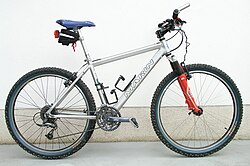
bicycle, often called a bike[1] (and sometimes referred to as a "pushbike",[2] "pedal bike",[3] "pedal cycle",[4] or "cycle"[5]), is a human-poweredpedal-drivensingle-track vehicle, having two wheels attached to a frame, one behind the other.[6] A person who rides a bicycle is called a cyclist, or bicyclist.
Bicycles were introduced in the 19th century and now number more than a billion worldwide, twice as many as automobiles.[7] They are the principal means of transportation in many regions. They also provide a popular form of recreation, and have been adapted for such uses as children's toys, adult fitness, military and police applications, courier services and bicycle racing.
The basic shape and configuration of a typical upright bicycle has changed little since the first chain-driven model was developed around 1885.[8] However, many details have been improved, especially since the advent of modern materials and computer-aided design. These have allowed for a proliferation of specialized designs for diverse types of cycling.
The invention of the bicycle has had an enormous effect on society, both in terms of culture and of advancing modern industrial methods. Several components that eventually played a key role in the development of the automobile were invented for the bicycle, including ball bearingspneumatic tires, chain-driven sprockets, and tension-spoked wheels.

gold

GOLD

Gold (play /ˈɡld/) is a dense, soft, shiny, malleable and ductile metal. It is a chemical element with the symbol Au and atomic number 79.
Pure gold has a bright yellow color and luster traditionally considered attractive, which it maintains without oxidizing in air or water. Chemically, gold is a transition metal and agroup 11 element. It is one of the least reactive chemical elements solid under standard conditions. The metal therefore occurs often in free elemental (native) form, as nuggets or grains in rocks, in veins and in alluvial deposits. Less commonly, it occurs in minerals as gold compounds, usually with tellurium.
Gold resists attacks by individual acids, but it can be dissolved by the aqua regia (nitro-hydrochloric acid), so named because it dissolves gold. Gold also dissolves in alkaline solutions of cyanide, which have been used in mining. Gold dissolves in mercury, formingamalgam alloys. Gold is insoluble in nitric acid, which dissolves silver and base metals, a property that has long been used to confirm the presence of gold in items, giving rise to the term the acid test.
Gold has been a valuable and highly sought-after precious metal for coinage, jewelry, and other arts since long before the beginning of recorded historyGold standards have been the most common basis for monetary policies throughout human history[citation needed], being widely supplanted by fiat currency starting in the 1930s. The last gold certificateand gold coin currencies were issued in the U.S. in 1932. In Europe, most countries left the gold standard with the start of World War I in 1914 and, with huge war debts, failed to return to gold as a medium of exchange.
A total of 165,000 tonnes of gold have been mined in human history, as of 2009.[2] This is roughly equivalent to 5.3 billion troy ounces or, in terms of volume, about 8500 m3, or acube 20.4 m on a side. The world consumption of new gold produced is about 50% in jewelry, 40% in investments, and 10% in industry.[3]
Besides its widespread monetary and symbolic functions, gold has many practical uses in dentistryelectronics, and other fields. Its high malleabilityductility, resistance to corrosion and most other chemical reactions, and conductivity of electricity led to many uses of gold, including electric wiring, colored-glass production and even gold leaf eating.
It has been claimed that most of the Earth's gold lies at its core, the metal's high density having made it sink there in the planet's youth. Virtually all of the gold that mankind has discovered is considered to have been deposited later by meteorites which contained the element. This supposedly explains why, in prehistory, gold appeared nuggets on the earth's surface[

DURIAN

DURIAN 


The durian (play /ˈdjʊriən/)[2] is the fruit of several tree species belonging to the genus Durioand the Malvaceae family[1][3] (although some taxonomists place Durio in a distinct family, Durionaceae[1]).
Widely known and revered in southeast Asia as the "king of fruits", the durian is distinctive for its large size, unique odour, and formidable thorn-covered husk. The fruit can grow as large as 30 centimetres (12 in) long and 15 centimetres (6 in) in diameter, and it typically weighs one to three kilograms (2 to 7 lb). Its shape ranges from oblong to round, the colour of its husk green to brown, and its flesh pale yellow to red, depending on the species.
The edible flesh emits a distinctive odour, strong and penetrating even when the husk is intact. Some people regard the durian as fragrant; others find the aroma overpowering and revolting. The smell evokes reactions from deep appreciation to intense disgust, and has been described variously as tert-Butylthiolalmonds, rotten onions, turpentine and gym socks. The odour has led to the fruit's banishment from certain hotels and public transportation in southeast Asia.
The durian, native to BruneiIndonesia and Malaysia, has been known to the Western world for about 600 years. The 19th-century British naturalist Alfred Russel Wallace famously described its flesh as "a rich custard highly flavoured with almonds". The flesh can be consumed at various stages of ripeness, and it is used to flavour a wide variety of savoury and sweet edibles in Southeast Asian cuisines. The seeds can also be eaten when cooked.
There are 30 recognised Durio species, at least nine of which produce edible fruit. Durio zibethinus is the only species available in the international market: other species are sold in their local regions. There are hundreds of durian cultivars; many consumers express preferences for specific cultivars, which fetch higher prices in the market.
ORANG UTAN
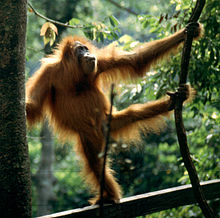
Orang utan Sumatera (Pongo abelii) merupakan salah satu daripada dua spesies orang utan. Ditemui hanya di pulau Sumatera di Indonesia, ia lebih jarang dan lebih kecil daripadaOrang utan Borneo. Orang utan Sumatera membesar sehingga ketinggiannya mencapai 1.4 meter (4.6 ka) dan berat sehingga 90 kilogram (200 lb) bagi orang utan jantan. Orang utan betina pula adalah lebih kecil, dengan purata ketinggian 90 sentimeter (3.0 ka) dan berat 45 kilogram (99 lb).
POKOK LIDAH BUAYA
Lidah Buaya adalah salah satu tumbuhan antara 250 spesis Aloe serata dunia. Aloe adalah tumbuhan asli kepada timur, selatan dan utara Afrika dan Madagascar dan telah diperkenalkan ke Hindia Barat dan negara-negara tropika yang lain, yang mana ia tumbuh liar. Ia juga telah membiak dengan baik di lembangan Mediterranean dengan merentasiAlgeriaMoroccoTunisia, serta kepulauan Canary dan Madeira. Lidah buaya telah digunakan sebagai ubatan tradisional untuk melegakan luka, ruam, demam, gatal-gatal, kulit dan banyak lagi.[perlu rujukan] Selain itu, pokok herba ini juga sangat popular dalam industri kosmetik dan produk kesihatan. Walaubagaimanapun ia masih kurang ditanam secara komersial di Malaysia